6489 Golevka
| 6489 Golevka | |
|---|---|

| |
| 6489 Golevka from AsteroidPack_v1.00.zip in Orbiter 2002P3 | |
| Designation | |
| Name | 6489 Golevka |
| Reference body | Sun |
| Planetary mean orbits | |
| Epoch | 2006 |
| Semimajor axis (a) | 373579090299.078 m |
| Eccentricity (e) | 0.605398743001474 |
| Inclination (i) | 2.277453662° (0.0397490649683287 radian) |
| Longitude of the ascending node (LAN, ☊) | 210.9561133° (3.68187875421545 radian) |
| Longitude of periapsis (ϖ) | 277.7770709° (4.84812447436596 radian) |
| Mean longitude (L) | 509.5582618° (8.8934693997637 radian) |
| Selected physical parameters | |
| Mean radius | 14000 km |
| Mass | 2.1×10¹¹ kg |
| Rotation elements | |
| SidRotPeriod | 21695.04 seconds (6.0264 hours) |
| SidRotOffset | 0 |
| Obliqutiy | 0 |
| LAN | 0 |
| Note | *Elements given are from 6489 Golevka.cfg (AsteroidPack_v1.00.zip) |
6489 Golevka is a prograde asteroid that was discovered by Eleanor F Helin in November 1991, and was given the designation 1991 JX at the time. In 1995, Goldstone in California, Yevpatoria in Ukraine, and Kashima Center in Japan simultaneously radar observed Golevka. The name Golevka comes from portions of the names of each of the observatories.
6489 Golevka in Orbiter
6489 Golevka was first introduced with the release of AsteroidPack_v1.00.zip in November 2004. Note that the landing surface as given in the config file is spherical, but the visual of Golevka is not, if you land, you will likely be above or below the visual surface. There is virtually no gravity on the surface of Golevka, even if you land carefully on the hard surface, you will drift off due to the Sun's gravity.
| Add-on | Source | Version | Author | Type | Release Date | Compatibility | Wiki article |
|---|---|---|---|---|---|---|---|
| Asteroid Pack 1.00 | O-F Resources | 2004-11-21 | Nighthawke | Scenery | 21 November 2004 | ||
See also
Gallery
-

6489 Golevka from AsteroidPack_v1.00.zip in Orbiter 2003P2 -

Series of radar images showing the rotation of Golevka in 1991
from Wikimedia Commons -

Computer generated images of Golevka based on Arecibo radar data
from Wikimedia Commons -
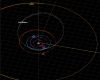
Orbit of 6489 Golevka from JPL Horizons orbit viewer


| edit The Solar System | |
|---|---|
| Central star |
Sun (Sol) |
| Planets |
Mercury - Venus - Earth - Mars - Jupiter - Saturn - Uranus - Neptune |
| Natural satellites |
Moon - Phobos - Deimos - Io - Europa - Ganymede - Titan - more... |
| Add-ons |
Planets - Dwarf Planets - Small objects - Natural satellites - Alternative star systems |