1566 Icarus
| 1566 Icarus | |
|---|---|

| |
| 1563 Icarus from Mercury_Crosser.zip in Orbiter 2005P1 | |
| Designation | |
| Name | 1563 Icarus |
| Reference body | Sun |
| Number of satellites | 0 |
| Planetary mean orbits | |
| Epoch | 2005.26351813826 |
| Semimajor axis (a) | 161256274149.496 m (1.07793161362956 AU) |
| Eccentricity (e) | 0.82680706411143 |
| Inclination (i) | 22.8520435408571° (.39884340059706 radian) |
| Longitude of the ascending node (LAN, ☊) | 88.0820692927929° (1.53732212112903 radian) |
| Longitude of periapsis (ϖ) | 119.379643206175° radian (2.08356783380383 radian) |
| Mean longitude (L) | 478.93856891753° (8.35905494240067 radians) |
| Rotational Elements | |
| Sidereal Rotation Period | 8182.944 seconds (2.273 hours) |
| Sidereal Rotation Offset | 0 |
| Obliquity | 0 radians 0.1° |
| LAN | 0 |
| Selected physical parameters | |
| Mean radius | 1400 m |
| Mass | 2.9×10<su>12 kg |
| Density | 4.05g/cm13 |
| Equatorial gravity | 0.0008 m/s2 |
| Orbital speed at surface | 0.6205 m/s |
| Escape velocity | 0.525 m/s |
| Gravity at surface | Icarus 31% Sun 69% |
| Note | *Elements given are from 1566 Icarus.cfg (Mercury_Crosser.zip). |
1566 Icarus (1949 MA) is object and a stony type asteroid. It was discovered by Walter Baade on 27 June 1949 at the Palomar Observatory.
The orbit of Bacchus varies from about 0.19 to 1.97 AU, which takes Icarus closer to the Sun than Mercury and farther away than Mars, revolving in about 409 days. Eccentricity is 0.83 and inclination is 23° to the ecliptic.
Bacchus is a stony asteroid, about 1.61 km × 1.60 km × 1.17 km, mean radius is about 0.50 km.
1566 Icarus in Orbiter
Icarus was introduced to Orbiter with the release of Mercury_Crosser.zip in June 2005.
Note that the landing surface as given in the config file is spherical, but the visual of Icarus is not, if you land, you will likely be above or below the visual surface. The gravity at the surface is about 0.0001 m/s2 barely enough to keep landed. The landing light on the Delta-glider works on Icarus.
| Add-on | Source | Version | Author | Type | Release Date | Compatibility | Wiki article |
|---|---|---|---|---|---|---|---|
| Mercury Crosser Asteroids | O-F Resources | 2005-06-01 | Nighthawke | Scenery | 2 June 2005 | all versions | |
See also
Gallery
-

1566 Icarus from Mercury_Crosser.zip in Orbiter 2005P1 -

Radar image of Icarus taken on 17 June 2015
from Wikimedia Commons -
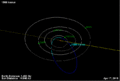
Orbit of Icarus compared to the orbits of the inner planets
from Wikimedia Commons -

Orbit of 1566 Icarus as depicted by JPL Horizons Orbit Viewer


| edit The Solar System | |
|---|---|
| Central star |
Sun (Sol) |
| Planets |
Mercury - Venus - Earth - Mars - Jupiter - Saturn - Uranus - Neptune |
| Natural satellites |
Moon - Phobos - Deimos - Io - Europa - Ganymede - Titan - more... |
| Add-ons |
Planets - Dwarf Planets - Small objects - Natural satellites - Alternative star systems |