38628 Huya
Jump to navigation
Jump to search
| 58534 Logos | |
|---|---|

| |
| 38628 Huya from Kuiper Objects Pack.zip in Orbiter 2006P1 | |
| Designation | |
| Name | 38628 Huya |
| Reference body | Sun |
| Planetary mean orbits | |
| Epoch | 2005.71598173516 |
| Semimajor axis (a) | 5942386458736 m |
| Eccentricity (e) | 0.28104 |
| Inclination (i) | 15.4519000014354° (0.269686530713964 radian) |
| Longitude of the ascending node (LAN, ☊) | 148.627519376271° (2.594039572187598 radian) |
| Longitude of periapsis (ϖ) | 236.500000056452° (4.12770368195187 radian) |
| Mean longitude (L) | 24.70671° (0.431213436835408 radian) |
| Selected physical parameters | |
| Mean radius | 500000 m |
| Mass | 3.456×10²⁰ kg |
| Rotation elements | |
| SidRotPeriod | 86400 seconds (24 hours) |
| SidRotOffset | 0 |
| Obliqutiy | 0.535467015 |
| LAN | 0 |
| Note | *Elements given are from Huya.cfg (Kuiper Objects Pack.zip) |
38628 Huya (2000 EB173) is a binary trans-Neptunian object located in the Kuiper Belt, also classified as a plutino having an orbital 3:2 resonance with Neptune.
38628 Huya in Orbiter
Huya is modeled as a single 500 km body. It was introduced to Orbiter with the release of the add-on Kuiper Objects Pack.zip in August 2006.
| Add-on | Source | Version | Author | Type | Release Date | Compatibility | Wiki article |
|---|---|---|---|---|---|---|---|
| Kuiper Objects Pack | O-F Resources | 2006-08-10 | markl316 | Scenery | 11 August 2006 | ||
See also
Gallery
-

38628 Huya from Kuiper Objects Pack.zip in Orbiter 2006P1 -

Huya and its companion imaged by Hubble in June 2019 -

Animated images of Huya and companion by Hubble in June and July 2002 -
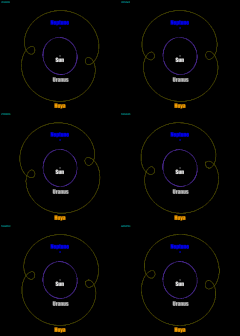
Animation of Huya's 2:3 resonance with Neptune keeping Neptune stationary


| edit The Solar System | |
|---|---|
| Central star |
Sun (Sol) |
| Planets |
Mercury - Venus - Earth - Mars - Jupiter - Saturn - Uranus - Neptune |
| Natural satellites |
Moon - Phobos - Deimos - Io - Europa - Ganymede - Titan - more... |
| Add-ons |
Planets - Dwarf Planets - Small objects - Natural satellites - Alternative star systems |